He@lio
Your AI copilot for mental well-being
Chat, guided activities, journaling, and goals — in one place.
Who It's For
Teens & Students
Ages 13–24
Stress From
School, home, social life
Looking For
Relief, habits, reflection
What It Does
AI Chat
Private support space
Activities
Quick relief coaching
Journaling
Mood + search views
Goals
Stats & badges
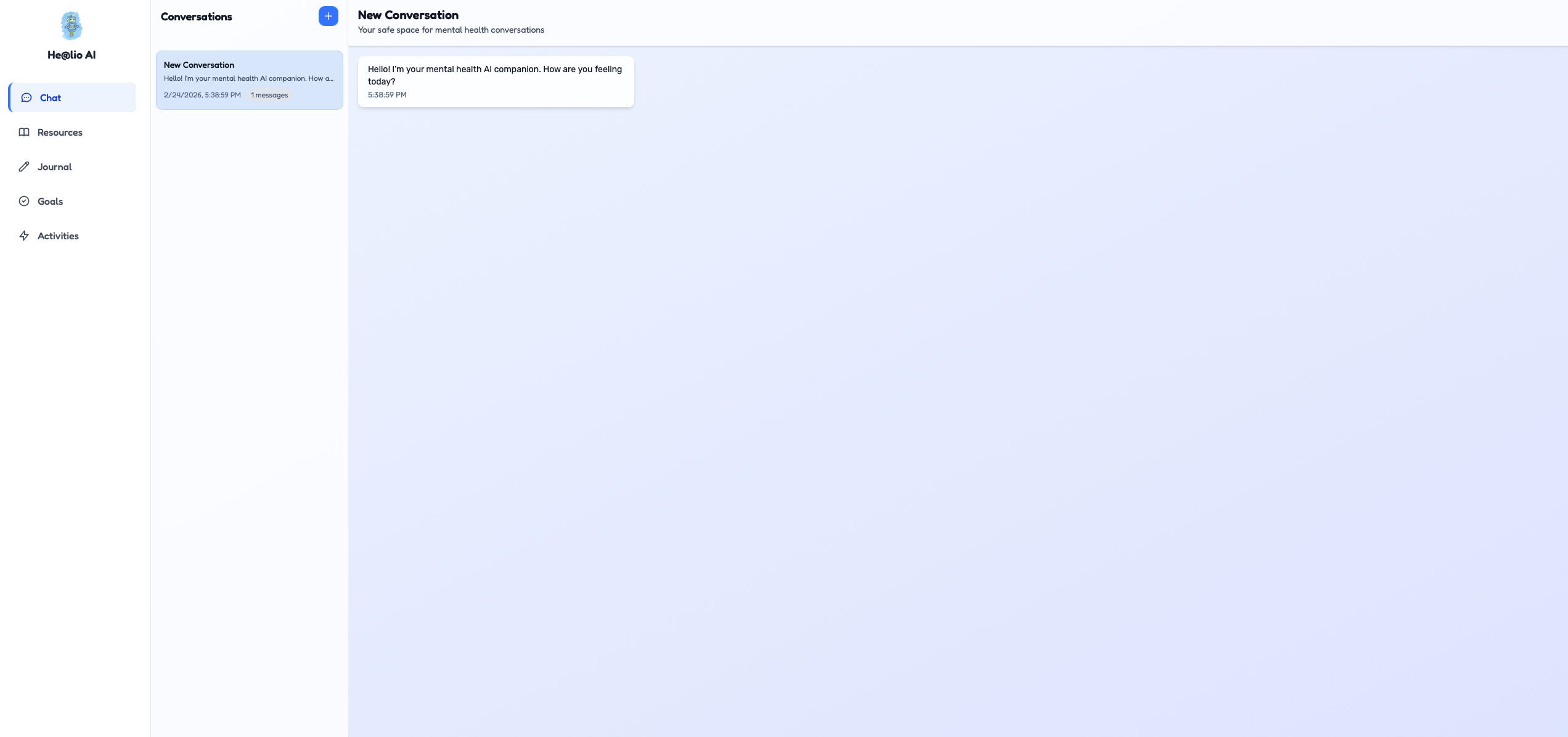
AI Chat Support
Your safe space for mental health conversations
- Built on large language model technology with RAG (Retrieval-Augmented Generation) — references your own journals and goals to personalise responses
- Age-adaptive tone calibrated for teens (13–17), college (18–21), and young adults (22–24)
- Motivational interviewing baked in — open questions, affirmations, and reflections
- Persistent conversation threads within each session
Guided Activities
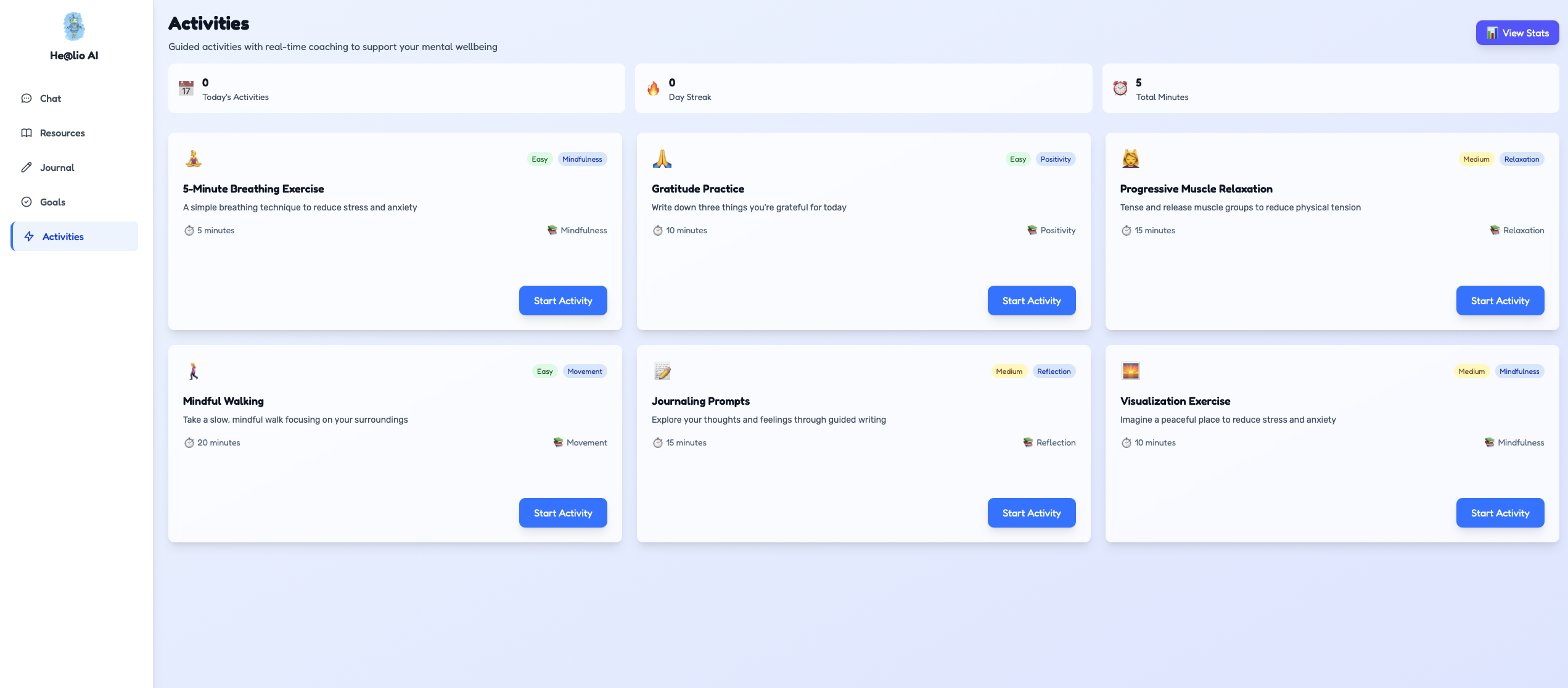
Guided activities that build healthy habits
- 15 wellness activities in total — 6 structured activities on the Activities page, with 9 more accessible through the AI chat
- Breathing exercises, grounding techniques, gratitude practice, and more
- Categorised by type, difficulty, and duration
- Streak tracking and stats to reinforce consistency
Journal & Insights
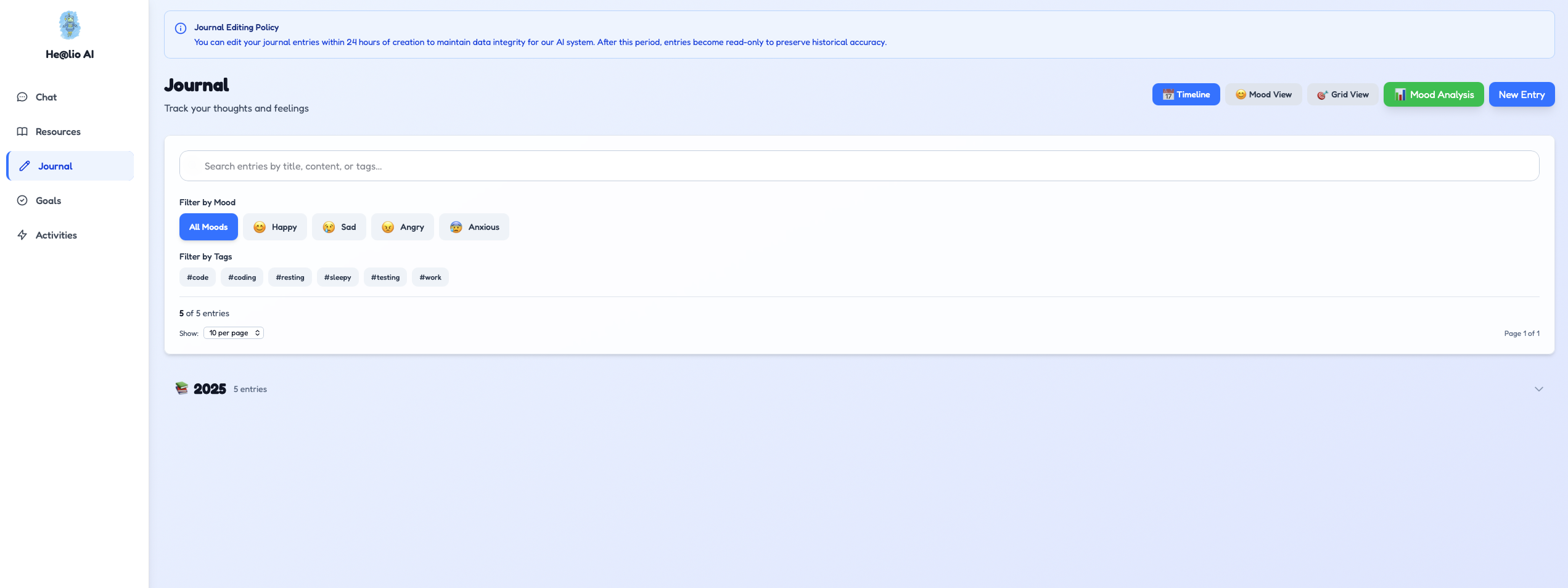
Journaling that helps you notice patterns
- Mood-tagged entries viewable by timeline, mood view, or grid
- Search by title, content, or tags
- Entries are read-only after 24 hours — preserves growth history and enables AI pattern detection
- Journal context is available to the AI chat for personalised responses
Goals & Achievements
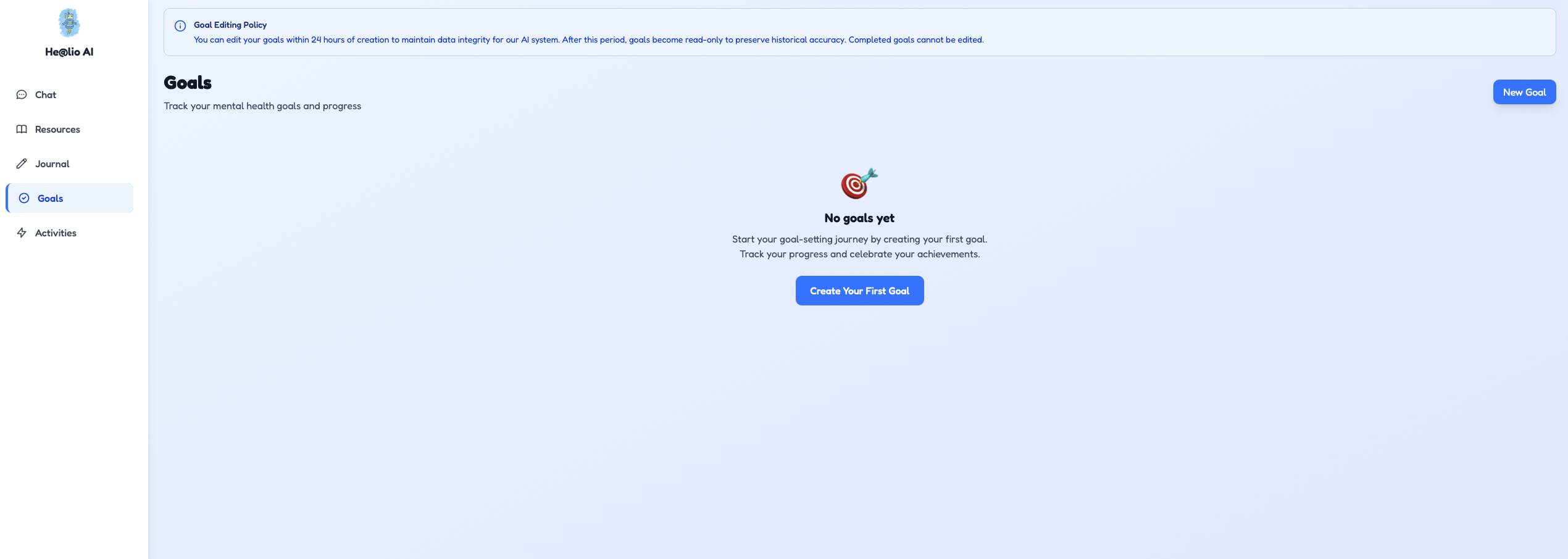
Turn intent into progress
- SMART goal creation with due dates and progress tracking
- Completion stats, current streak, and success rate at a glance
- Achievements and badges celebrate milestones
- Goal context feeds into AI chat for accountability
Impact
24/7
availability
Accessible Support
- Contextual AI chat, anytime
- Faster than searching for answers
15
wellness activities
Builds Healthy Habits
- Supportive design, not distracting rewards
- Celebrations reinforce behaviour
4
mood levels
Know Yourself
- Mood insights + Journal depth
- Goals turn intent into progress
Privacy & Safety
- Secure authentication and protected routes — all data is user-controlled and privately isolated per account.
- Data deletion available at any time. We do not sell or share user data.
- Not a substitute for clinical care. Crisis resources are surfaced automatically when safety signals are detected.
- Built on edge infrastructure — data is processed at 300+ global edge locations, never centralised.
Project Overview
History
He@lio was born during the early stages of the pandemic, addressing the rising mental health challenges among youth. The idea emerged from a storytelling session on AI by local entrepreneur Chad Oda. Youth members of Bellevue Youth Link Board and Youth Council took on the challenge of learning computer science and building the first version themselves — starting with Microsoft Virtual Agent, evolving through Voiceflow, and graduating to a ChatGPT-based API. In 2025, He@lio was rebuilt from the ground up as a full standalone web application with its own backend, database, and AI system.
Started by Bellevue Youth Link's Mental Health subgroup — ideated the text chatbot based on Microsoft Virtual Agent.
Migrated from text to a conversational AI program called Voiceflow.
Adapted ChatGPT and moved to the 3rd iteration of He@lio.
Applied to NSF (National Science Foundation) & qualified as "Human-centric design", advancing to the next stage.
Rebuilt as a standalone web application — full AI features, edge-native architecture (Cloudflare Workers), and age-adaptive tone.
Active research pilot launched with University of Washington MSIM Capstone team to evaluate safety, effectiveness, and AI interaction quality.
How He@lio Started
University of Washington MSIM Capstone
He@lio is currently being evaluated by a team of Master of Science in Information Management (MSIM) students at the University of Washington as part of their Capstone project. The research focuses on AI safety, interaction quality, and responsible design in mental health contexts.
View Research ProgramWhy He@lio Works
Research-Backed
Journaling helps accept rather than judge mental experiences, resulting in fewer negative emotions (Ford, Lam, John, & Mauss, 2018; Baikie & Wilhelm, 2005).
Unique Approach
Encourages active reflection on thoughts, walking participants through positive thinking using the OARS motivational interviewing technique.
Non-Judgmental
A good alternative for people who don't feel comfortable with face-to-face conversations. Validates feelings without judgment — strengths-based language throughout.
Personalised by Context
The AI references your own past journals and goals within a session to provide relevant, personalised responses — not generic advice.
Active Feedback
Provides strategies and resources for overcoming challenges, and routes automatically to crisis resources when safety keywords are detected.

Join the Team
Time Commitment
1–2 hours per week
Experience
No experience necessary — we'll teach you everything.