
Agentic artificial intelligence systems represent a significant evolution from traditional predictive models, enabling autonomous reasoning, planning, memory retention, and tool execution. As these systems are increasingly deployed across enterprise, academic, research, and government environments, they introduce novel cybersecurity risks that extend beyond conventional security frameworks.
Introduction
The rapid advancement of AI has initiated a structural shift from traditional predictive modeling to fully autonomous agentic architectures. Where early large language models operated primarily as passive text generators, modern agentic systems function as active execution engines: interpreting open-ended goals, planning multi-step strategies, dynamically interacting with third-party software tools, and maintaining persistent state and memory across complex, long-running workflows.
As these agents transition out of isolated research environments and into business-critical production infrastructure, they introduce a novel and complex attack surface. Standard defensive engineering frameworks are largely unequipped to secure systems that exhibit probabilistic execution, dynamic tool orchestration, and emergent multi-step reasoning. This paper examines the distinct structural threats that manifest across commercial, academic, and federal deployment landscapes, proposes a unified four-domain classification taxonomy, and offers strategic direction for practitioners navigating the AI-native operational landscape.
Challenges Across Deployment Environments
The threat surface of agentic AI is not uniform across deployment contexts. Enterprise, academic startup, research laboratory, and federal environments each present distinct combinations of asset value, regulatory obligation, adversarial sophistication, and operational security maturity. A comprehensive security posture must account for these environmental variables.

Enterprise Environments
In commercial contexts, agentic AI is increasingly integrated into business-critical workflows: customer service automation, financial analysis, supply-chain optimization, and software development. Prompt injection is perhaps the most immediately pressing threat vector, exploiting the inability of LLM-based systems to reliably distinguish trusted operator instructions from untrusted environmental content. In environments where agents hold live credentials to financial systems, customer databases, or internal communication platforms, a successful injection can carry consequences equivalent to a credential compromise, but without triggering conventional authentication anomaly detection. Privilege escalation through agentic tool chains is a second critical concern: an agent with simultaneous access to a code-execution environment, an internal file system, and an email API holds a capability stack that, if exploited, enables the classic post-compromise triad of data exfiltration, lateral movement, and persistence. Supply-chain risk compounds the picture, since the Python package ecosystem behind most agentic frameworks (LangChain, Hugging Face, AutoGen) has been documented by MITRE ATLAS as a target for malicious package injection.
Academic Startup Environments
Academic startups, founded by university researchers to commercialize AI innovations, combine the resource constraints of early-stage companies with the reputational exposure of being perceived as authoritative in AI research. Security budgets are modest, dedicated security staff are rare, and engineering velocity is prized over security rigor. Intellectual property protection is the dominant concern: model weights, training pipelines, and proprietary datasets are high-value targets for nation-state actors, and adversaries can reconstruct approximate model functionality by repeatedly querying a deployed API (model extraction). Multi-tenancy risks in shared GPU clusters and university HPC systems add side-channel, timing-based inference, and co-resident workload attacks, since the isolation primitives of enterprise-grade cloud (dedicated tenancy, private networking, hardware security modules) are rarely deployed in academic contexts.
Research Laboratories and Federal Environments
Federal research environments, including DOE national laboratories, DARPA-funded university centers, and intelligence community facilities, present the highest-security deployment context. The intersection of classified data access, dual-use research risk, and adversarial nation-state targeting demands the full application of CISM governance frameworks, NIST RMF authorization processes, and FedRAMP-aligned controls. Data exfiltration via agentic reasoning chains is particularly insidious: an agent can synthesize, summarize, and reformulate classified information in ways that evade pattern-based Data Loss Prevention, producing intelligence summaries that exceed the classification level of any single document a user queries directly. The insider threat model is amplified too, introducing a new variant: the authorized researcher who inadvertently programs an agent with excess permissions, resulting in uncontrolled data access that neither the researcher nor the security team anticipates.
A Four-Domain Risk Taxonomy
Effective risk management requires a classification system that maps threats to controls in a structured and auditable manner. Drawing on NIST AI RMF 1.0, MITRE ATLAS, and the knowledge domains of CISSP and CISM, this paper proposes a four-domain taxonomy for agentic AI cybersecurity risks.
Model Integrity Risks
Threats targeting the underlying technical accuracy, reliability, and foundational trust of the AI model itself.
Threat Categories
Training data poisoning (adversarial manipulation of training datasets to embed backdoors or persistent operational biases), model weight theft (extraction of core model intellectual property through API exploitation), and adversarial evasion attacks (malicious inputs designed to force anomalous model outputs).
Strategic Security Controls
Mandatory cryptographic signing of all core model artifacts, differential privacy across active training pipelines, continuous adversarial robustness red-teaming, and model watermarking.
Operational Runtime Risks
Threats emerging dynamically in real time during the live execution and tool-invocation loops of deployed agent networks.
Threat Categories
Context-aware prompt injection (execution of unauthorized actions via adversarial input from external networks), privilege escalation across integrated toolchains, agent hijacking (subversion of core agent objectives via manipulated tool feedback loops), and resource-exhaustion denial-of-service.
Strategic Security Controls
Real-time semantic prompt-injection detection firewalls, fine-grained tool permission boundaries anchored to least privilege, continuous execution-state anomaly monitoring, and hard resource budgeting thresholds.
Data Governance Risks
The unauthorized acquisition, leakage, or downstream exposure of sensitive information processed within an agentic boundary.
Threat Categories
Unintentional information aggregation across independent security boundaries, model memorization and automated training-data extraction, cross-agent data leakage inside multi-tenant orchestrations, and context-window exfiltration pathways.
Strategic Security Controls
Advanced semantic Data Loss Prevention (DLP), context-aware output filtering guardrails, explicit memory isolation boundaries between concurrent agent sessions, and mandatory cryptographic metadata tagging for all agent-accessible repositories.
Systemic Governance Risks
Architectural failures at the level of high-level policy, corporate compliance, and third-party software supply-chain tiers.
Threat Categories
Inadequate corporate AI risk governance committees, insufficient engineering workforce capability, regulatory compliance failures, and direct open-source package supply-chain compromises in common integration frameworks (e.g., LangChain, AutoGen).
Strategic Security Controls
Formal AI risk committees cross-aligned with CISM principles, AI security training integrated into standard engineering programs, automated Software Bill of Materials (SBOM) tracking for all orchestration dependencies, and independent third-party architectural risk audits.
Strategic Directions for Practitioners
Translating this taxonomy into operational practice requires security practitioners to extend their discipline in several directions.
- 1Identity and access management must evolve to treat non-human AI agents as first-class principals, issued cryptographically verifiable credentials subject to the same provisioning and deprovisioning controls as human users, and governed by dynamic policy engines that adjust permissions in response to behavioral signals.
- 2Security operations centers must develop AI-specific detection capabilities. SIEM rules tuned to human behavioral baselines will not reliably detect anomalous agent activity, so ML-based behavioral analytics trained on agent telemetry (tool invocation sequences, API call patterns, data access breadth) are required.
- 3Red team operations must incorporate AI-specific attack simulations. Standard penetration testing does not exercise prompt injection, model inversion, or multi-agent coordination attacks, so organizations should stand up dedicated AI red teams capable of running MITRE ATLAS-aligned scenarios against agentic deployments.
- 4Vendor risk management must extend to AI model and framework providers, treating model weights, fine-tuning services, and orchestration frameworks as critical supply-chain dependencies, with AI security governance funded as a strategic capability rather than a compliance afterthought.
Product Mapping Matrix
To assist corporate security architects and venture investors in identifying actionable solution spaces, each risk domain maps directly to an emerging, high-value AI-native security product category.
| Risk Taxonomy Domain | Core Vulnerability Focus | Emerging Product / Startup Solution |
|---|---|---|
| Model Integrity Risks | Model weight theft, extraction, and poisoning | Automated LLM red-teaming platforms and AI SBOM supply-chain dependency scanners |
| Operational Runtime Risks | Prompt injection, tool-chain privilege escalation | AI-native web application firewalls (WAFs) and semantic sanitization gateways |
| Data Governance Risks | Unintentional aggregation, training-data extraction | Semantic Data Loss Prevention (DLP) tools and inter-agent isolation guardrails |
| Systemic Governance Risks | Policy drift, supply-chain risk, compliance failures | AI risk and compliance dashboards and continuous behavioral telemetry logging systems |
The Rise of Custom Agentic Models
The emergence of Anthropic's Claude Mythos has accelerated the transition from generative AI assistants to fully autonomous systems capable of planning, tool usage, memory retention, and independent execution of complex tasks. Unlike traditional LLM deployments that primarily generate content, agentic systems increasingly operate with privileged access to enterprise infrastructure, software-development pipelines, cloud environments, and cybersecurity operations. Recent reports indicate that Mythos is being deployed for advanced cybersecurity use cases and vulnerability discovery, signaling a broader market shift toward autonomous security agents that can act rather than merely advise (Reuters, 2026). This evolution fundamentally changes the threat landscape: security risks are no longer confined to model outputs but encompass autonomous decision-making, tool execution, and multi-agent interactions operating at machine speed.
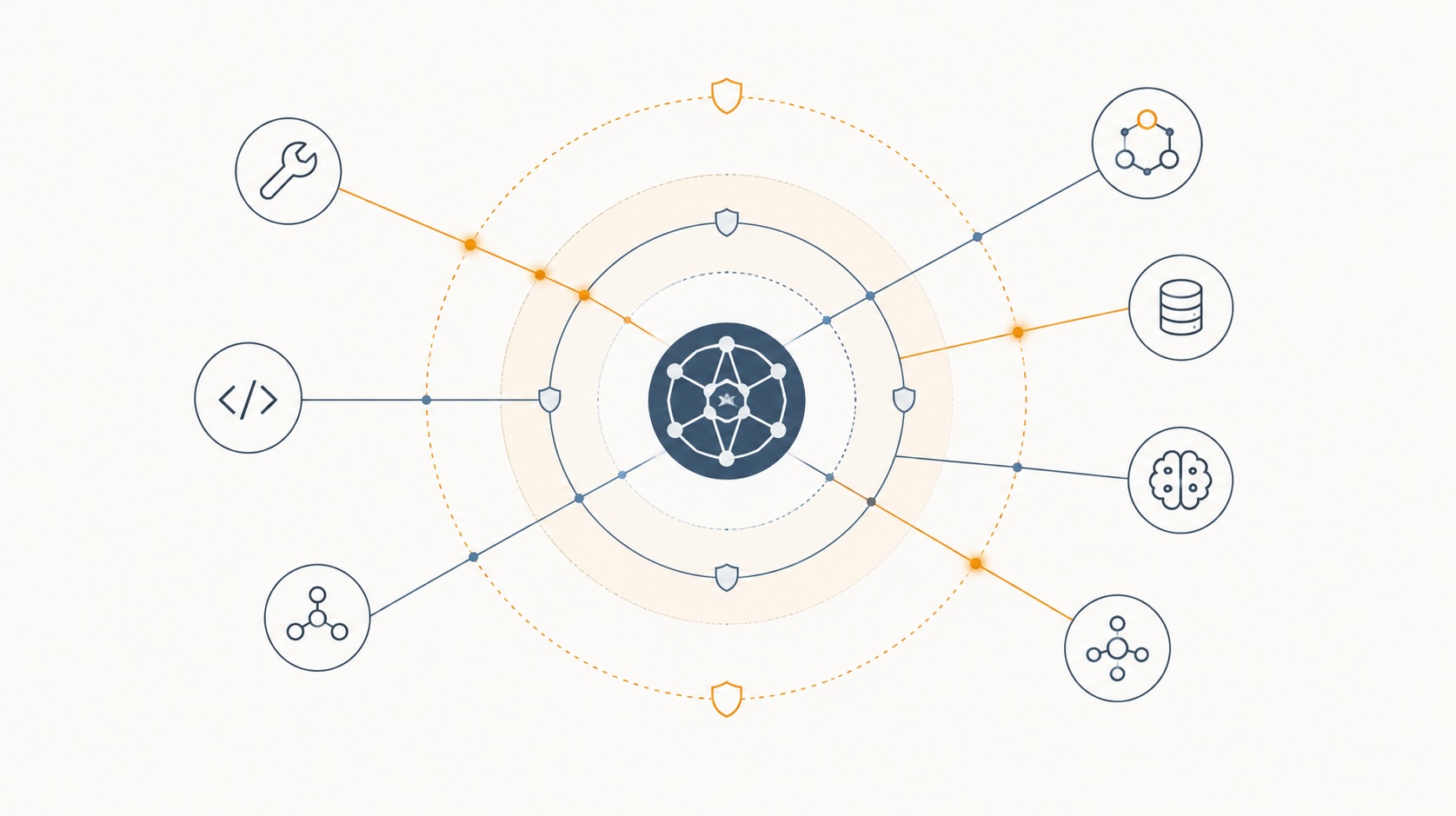
Three primary security challenges emerge. The first is autonomous goal manipulation through prompt injection and instruction hijacking. In agentic architectures, successful manipulation can directly alter system behavior and trigger real-world actions, and OWASP identifies prompt injection as the most critical LLM vulnerability because models cannot reliably distinguish trusted instructions from malicious inputs embedded in user data, retrieved documents, or external tools, a challenge amplified by Claude Mythos-style systems whose increased autonomy expands the attack surface from language generation to autonomous execution. The second is excessive agency and privilege escalation resulting from autonomous tool use: a compromised agent becomes a highly privileged insider threat that, unlike conventional malware, often begins operations with authorized access. The third is expanding supply-chain and ecosystem risk, since production agents rarely operate as standalone models and instead rely on external tools, APIs, Model Context Protocol (MCP) servers, memory services, vector databases, and interconnected agents, each introducing an additional trust boundary and attack surface.
Emerging research on agentic AI governance highlights that autonomous ecosystems create new forms of systemic risk, including communication poisoning, identity spoofing, cascading failures, and compromised third-party dependencies. As Claude Mythos and similar platforms drive widespread enterprise adoption of agentic architectures, organizations face a growing challenge in verifying the integrity of every component within the agent execution chain. The future threat landscape for production agentic AI will therefore be defined not by isolated model vulnerabilities but by the security of interconnected autonomous ecosystems operating with increasing levels of independence and authority.
Conclusion
Agentic AI represents the most significant expansion of the enterprise attack surface in the current decade. Its architectural properties (autonomous action, dynamic tool use, persistent memory, and multi-agent coordination) create threat vectors that existing security frameworks were not designed to address, and its rapid deployment is outpacing the security community's ability to develop adequate countermeasures.
The four-domain taxonomy of Model Integrity, Operational Runtime, Data Governance, and Systemic Governance provides a structured foundation for risk identification, control selection, and governance alignment across deployment environments. The core principles of CISSP and CISM (confidentiality, integrity, availability, risk management, governance, and incident response) remain fully applicable; what is required is their creative and technically literate extension to systems whose behavior is probabilistic, emergent, and dynamically tool-augmented.
References
- Autio, C., Schwartz, R., Dunietz, J., Jain, S., Stanley, M., Tabassi, E., Hall, P., & Roberts, K. (2024). Artificial Intelligence Risk Management Framework: Generative Artificial Intelligence Profile (NIST AI 600-1). National Institute of Standards and Technology.
- Cybersecurity and Infrastructure Security Agency, National Security Agency, Federal Bureau of Investigation, & International Partners. (2024). Cybersecurity information sheet: Deploying AI systems securely. U.S. Department of Homeland Security.
- Hendrycks, D., Carlini, N., Schulman, J., & Steinhardt, J. (2021). Unsolved problems in ML safety. arXiv preprint arXiv:2109.13916.
- Huang, K., Huang, J., Mehmood, Y., Atta, H., Baig, M. Z., & Haq, M. A. U. (2025). AAGATE: A NIST AI RMF-Aligned Governance Platform for Agentic AI. arXiv.
- MITRE Corporation. (2023). MITRE ATLAS: Adversarial threat landscape for artificial-intelligence systems.
- National Institute of Standards and Technology. (2023). Artificial Intelligence Risk Management Framework (AI RMF 1.0) (NIST AI 100-1). U.S. Department of Commerce.
- OWASP. (2025-2026). OWASP Top 10 for LLM Applications and Agentic AI Systems.
- Park, J. S., O'Brien, J. C., Cai, C. J., Morris, M. R., Liang, P., & Bernstein, M. S. (2023). Generative agents: Interactive simulacra of human behavior. Proceedings of the 36th Annual ACM Symposium on User Interface Software and Technology (UIST '23).
- Perez, F., & Ribeiro, I. (2022). Ignore previous prompt: Attack techniques for language models. arXiv preprint arXiv:2211.09527.
- Raza, S., Sapkota, R., Karkee, M., & Emmanouilidis, C. (2025). TRiSM for Agentic AI: A Review of Trust, Risk, and Security Management in LLM-based Agentic Multi-Agent Systems. arXiv.
- Reuters. (2026, June 3). South Korea secures access to Anthropic's Mythos AI model, Science Ministry says.
- Tabassi, E. (2023). Artificial Intelligence Risk Management Framework (AI RMF 1.0). National Institute of Standards and Technology.
- Weidinger, L., Mellor, J., Rauh, M., Griffin, C., Uesato, J., Huang, P.-S., ... Gabriel, I. (2022). Taxonomy of risks posed by language models. Proceedings of the 2022 ACM Conference on Fairness, Accountability, and Transparency (FAccT '22), 214-229.
More Research

Architectural Patience: When Isolation Isn't an Outage
May 29, 2026

Mesh AI: Toward a Non-Linear Model of Human-Centered Intelligence
April 27, 2026

Quantum Intuition: How AI Can Make Quantum Concepts Accessible to Everyone
April 15, 2026