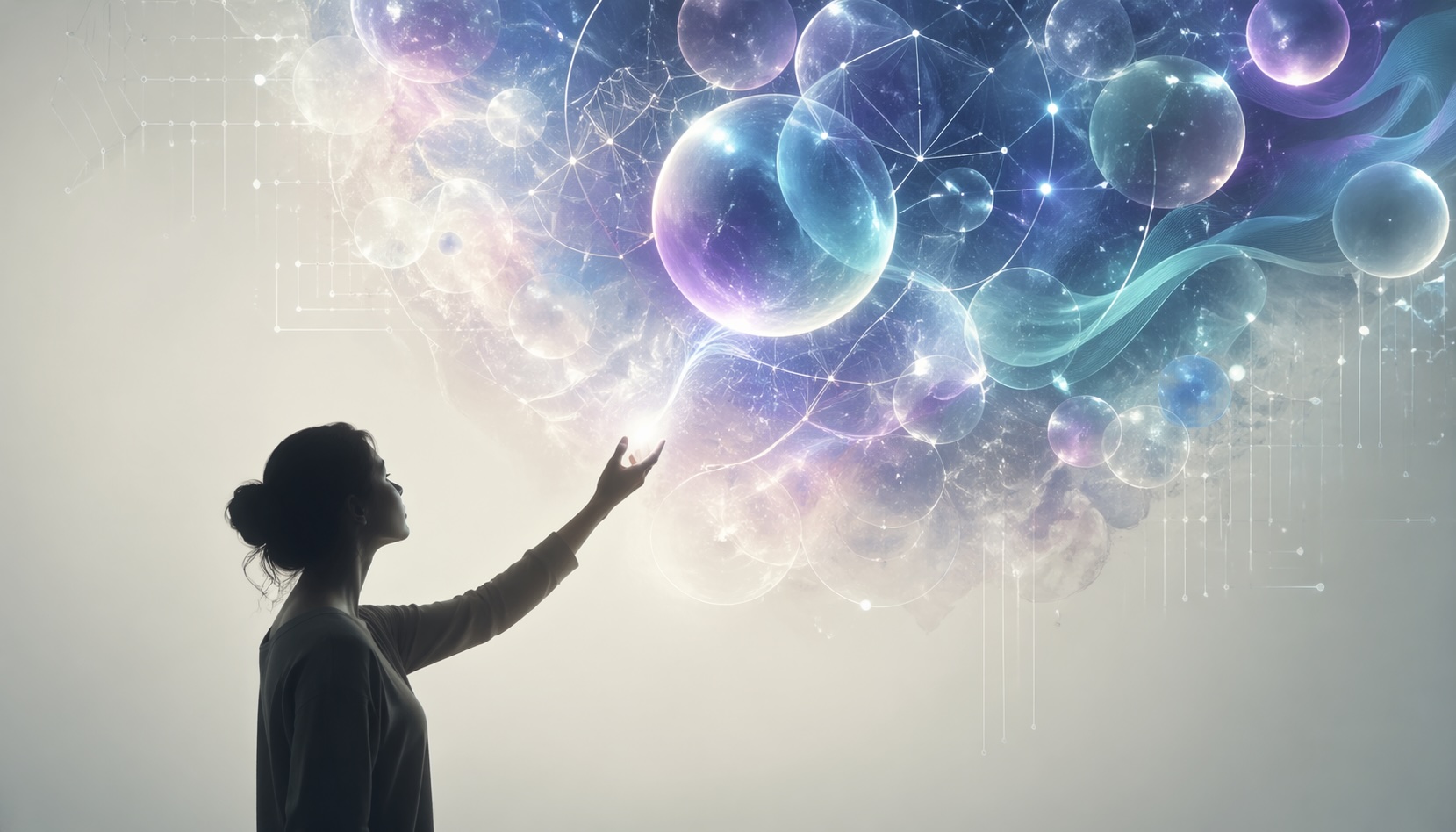
Quantum computing gets talked about constantly and understood rarely. For most people it sits somewhere between science fiction and academic abstraction, reserved for those with advanced degrees in physics or mathematics. This piece starts from a different angle. What if the goal is not to teach quantum mechanics at all, but to help people build quantum intuition? If so, where does AI fit?
The Accessibility Gap
The idea that something can be in two states at once (superposition). That two particles can stay linked once they meet, no matter how far apart they end up (entanglement). That possibilities can cancel each other out before anything is measured (interference). None of these are inherently impossible to grasp. The barrier is not the concept, it is the entry point. Most educational pathways ask for years of mathematical foundation before anyone is allowed near the ideas themselves. That turns into a kind of gatekeeping by accident. The people who might benefit most from thinking in quantum terms rarely get the chance to try.
Research does not have to be the exclusive territory of PhD programs or elite institutions. Accessible AI tools and free quantum simulators are starting to change what a curious person can do on their own. New kinds of inquiry open up. The kind driven by cross-domain thinking, and a beginner's willingness to ask questions that specialists sometimes stop asking.
Intuition Over Equations
Understanding quantum mathematics and developing quantum intuition are two different things. The first demands years of formal study. The second is closer to a habit of mind: reasoning about uncertainty, overlapping states, and the way observation can change an outcome. That habit can be built through experience and interaction, not only through equations.
This piece focuses on that second path. The question shifts from "how do we teach quantum mechanics" to "how do we help more people think in ways that quantum concepts make possible." It is a smaller question in some ways, and a much larger one in others.
Before going further, here are the ideas this piece keeps returning to. Each one is something you can picture, no equations needed.
Concepts You Can Feel
Six big ideas, no math required.
Superposition
Many possibilities at once, until you look.
A coin mid-spin: not yet heads or tails.
Entanglement
Two particles linked, however far apart.
Like two coins that always land opposite, worlds apart.
Interference
Possibilities can add up or cancel out.
Like ripples meeting: some peaks grow, some vanish.
Measurement
Looking changes the outcome.
Checking the spinning coin forces it to land.
Uncertainty
You can't pin down everything at once.
Pin down where it is, and its speed goes blurry.
Decoherence
Quantum states are fragile and fade fast.
Nudge it, and it acts like ordinary matter again.
AI as an Accessibility Layer
AI sits in an interesting position here. Not as a replacement for the mathematics, but as an interpreter. It can translate quantum behavior into language and interaction that build intuition, without the usual prerequisites.
Free quantum simulators already let anyone run a small circuit and see its result. On their own, those results mean very little without training. They come out as numbers and charts that are hard to read without context. An AI layer could change that. It could describe what the circuit did, why the result looks the way it does, and how the behavior differs from anything a classical system would produce.
That reframes AI. Not a shortcut around quantum understanding, but a translator between two worlds: the mathematical reality of quantum systems on one side, and the intuitive everyday reasoning most people use on the other.
Gamification as a Method
One approach worth exploring is gamification. The idea is to design interactive experiences where the rules of the game are quantum rules. Players do not learn about superposition in the abstract. They navigate it. They do not read about interference. They watch their own choices interfere with each other.

The idea is not new. There are already browser-based quantum games where players experiment with light, mirrors, and tiny quantum particles to solve puzzles, learning the rules through play rather than equations. The goal is not to disguise learning as fun. It is to acknowledge that intuition grows out of experience, and games happen to be one of the most efficient ways to create structured experience.
Combined with an AI layer that contextualizes each interaction, gamification creates a feedback loop. Play. Experience quantum behavior. Ask what just happened. The next round starts from a slightly different place than the one before.
Why This Matters
Quantum computing is likely to reshape computation, cryptography, and materials science over the coming decades. If the conceptual foundation of that shift stays locked behind academic gatekeeping, the people making decisions about quantum technology in policy, investment, education, and product will be operating without intuition for what they are actually dealing with.
Making quantum intuition accessible is not the same thing as dumbing it down. It is recognizing that the entry point matters as much as the destination. Used thoughtfully, AI can lower that entry point without distorting what sits on the other side.
This work is part of a broader commitment at Compassion8Innovation to explore how emerging technologies can be made genuinely accessible. Not just technically available, but humanly approachable.
Want to discuss this work?
Have questions or want to collaborate? Reach out below.
More Research
Threat Landscape: Security Risks in Production Agentic AI Systems
June 13, 2026

Architectural Patience: When Isolation Isn't an Outage
May 29, 2026
Mesh AI: Toward a Non-Linear Model of Human-Centered Intelligence
April 27, 2026